Beginners Guides: Internet Connection Sharing
Learn how to make that DSL/Cable connection go further -
Version 1.1.0
Internet sharing is essential
if you have more than one PC in your house, and getting it to work isn't that
hard once you know what steps to follow.
Setting up a computer to
share its internet connection should be easy right? After all, you've
successfully networked your computers together and even shared files with all
your home computers, so why not the Internet? Well if you have a small home network of computers all connected and
have tried to open up a browser, you've probably found out that things aren't
quite as straight forward as connecting one machine with an Ethernet cable to
the computer that has the DSL/cable modem.
The secret is that everything
comes down to having a gateway.
A gateway is a computer or
device than can route data between different networks. Put it this way, if your
computers are on one network and every other computer connected to the Internet
is on a different one, to pass information across network boundaries you need a
device which is connected to both networks and equipped to decide whether
information from one network should go out to the other network, and vice versa.
So, without a gateway there is no way for the other computers
in your network to receive or pass information to the other networks,
and consequently, they have no Internet access.
The computer in your small network which is
directly connected to the cable or DSL modem is provided with a default gateway
by the Internet service provider. That allows
the computer to connect to the interenet, but unfortunately for us that gateway
is not part of your home network - rather it is a separate network formed
between the computer connected to the cable/DSL modem and the ISP itself.
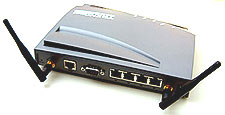 |
| This wiresless router fromTrendNet is just one example of what could be used to share internet access
from a DSL/Cable modem to multiple computers in a home
network. |
In order to enable Internet
access on the rest of your small home network, the computer or device that
connects with your ISP must become a gateway for the computers in your local
home network. Once this has been configured, it will enable all of the other
home network computers to access the Internet by sending and receiving
information through that gateway.
The easiest way of acquiring a
gateway for your home network is to buy a cable/DSL router. Given how cheap
they currently are (about a quarter of the price they commanded when they first
appeared in the marketplace), there really isn't much of an excuse not
to buy one.
The major advantages of having a hardware router doing your internet
sharing include minimal configuration, since they are set up to act as a gateway
by default (it's pretty much all they do), increased reliability (they are not a
PC… PCs crash.), and security, since most of these devices incorporate a
firewall. Highly recommended!
The other alternative is to set up Internet connection sharing (ICS)...





 RSS Newsletter