Intel Pentium 4 540 (3.2E) Socket LGA 775 Processor
Review
In June of
2004, Intel introduced a host of
new technologies that ranged from PCI Express to DDR-2, and even retired
old standards in favour of the emerging BTX form factor. All this came about with the 915P
and 925X chipsets, and of course the pinless socket 775 Pentium 4 3.2E processor (otherwise known
as the Pentium 4 540 based on Intel's new model numbers).
The other
technologies aside, why did Intel move in such a radical direction with the
LGA775 Pentium 4? Well, one of the main problems that had plagued Socket 478
processors was
broken pins. With the new processor pushing pin density up by 297 contacts, layout and
damaged connectors were bound to be an issue unless the package size was
also enlarged. The solution Intel engineers came up with was to remove the
pins from the CPU,
replace them with a denser array of gold contact points, and relocate the pins into the
CPU socket itself.
These
changes have made the LGA775 Intel Pentium 4 processor a little more durable, while
allowing connector density to increase without radically enlarging the
package size. Conversely,
the new socket 775 is now extremely fragile, and instead of dealing with damaged
CPU pins, careless users could be left with damaged sockets and useless motherboards as
a consequence. In theory, the new socket themselves are also much more vulnerable to
wear and tear with repeated installations... None of this should really affect the
average consumer, but it may certainly impact enthusiasts who swap out CPUs all day in
search of better and bigger speeds. Whichever category you fall into, LGA775 Pentium 4
processor installation is now a tense operation - so read those instructions!
The Pentium 4 3.2E LGA775 (Land
Grid Array) Socket 775 processor is based on the same 0.09 micron manufacturing
process as its Socket 478 Prescott cousin. Actually, the CPU is based
on the same 'Prescott' core as is found within Socket 478 CPUs; and includes
the 31-stage pipeline which is 50% longer than that found in the
'Northwood' core Pentium 4 processors, with a 16KB L1 cache and a large 1MB
L2 cache.
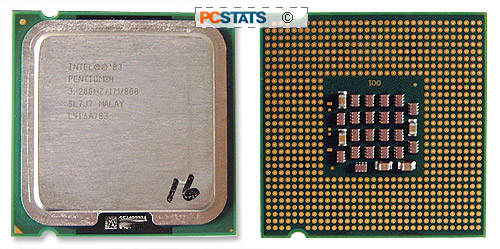
The Socket
775 Pentium 4 3.2E still incorporates
the integrated heat spreader (IHS) to help protect the underlying silicon core from physical damage. It
is made from nickel-plated copper and presents a larger surface area for heatsinks to work with. As
you may notice from the marketings on the IHS, the 3.2E processor PCSTATS is testing is
based on the D0 stepping (S-Spec SL7J7) and was produced in the end of March or early
April of 2004.
Note that while the bottom of the Pentium 4 540 processor
is pinless, it is not entirely flat. At the center of the processor package are
resistors and capacitors; both these electrical components and the small gold contacts are fragile, and the documentation recommends against touching
them with your fingers.
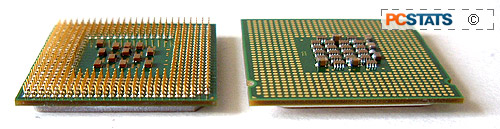
Now that
the
socket has all the pins, it's vital that LGA775 Pentium 4 processors are installed
correctly, and in the right orientation. That's why Socket 775 processors have two
keys on opposite sides off-center. You align them with the socket keys which
helps guide the processor correctly into place.






 RSS Newsletter