BACK TO PCSTATS + Motherboards
+ Videocards
+ Memory
+ Beginners Guides
News & Advanced Search  Feedback?
[X]   Directory of
Guides & Reviews
The PCstats Forums

Nov. ShoppingList
Beginners Guides
Weekly Newsletter
Archived Newsletters

  Press Releases
  Tech Glossary
  Folding Team
  3DMark Team
  Forum Team

+70 MORE Beginner GUIDES....
Poll: Windows 7 Upgrade?
Are you planning on upgrading to Windows 7 on Oct. 28th?
Yes, Windows 7 Here I come!
No, Windows XP still works
No, Windows Vista still works
Total Votes:  3958

 
The Rydium Network
DIY Guides: How To Install/Remove Intel Socket 775 CPU and Heatsink
DIY Guides: How To Install/Remove Intel Socket 775 CPU and Heatsink - PCSTATS
Abstract: With Intel's latest processor socket 775 formfactor, Intel has accomplished a couple of noteworthy things. The first was to substantially reduce the complexity and cost of manufacturing.

 mfg'r link     category     date published     author    
  Intel   Beginners Guides   Jan.08.09   Mike D.  


With Intel's socket 775 processor formfactor, Intel has accomplished a couple of noteworthy things. The first was to substantially reduce the complexity and cost of manufacturing its processors; removing the vulnerable and delicate interface pins from the bottom of CPUs meant that manufacturing losses and customer returns both dropped significantly for Intel. The second accomplishment was, unfortunately, to increase the complexity and risk involved in installing one of the new 775 processors into a motherboard.

By removing the pins from each CPU, Intel off loaded the responsibility of adding interface pins to motherboard manufacturers (who also now have to deal with returned merchandise and angry customers with bent socket pins). This is a bad thing for Intel users in general, as now the motherboard is the most likely component to be damaged during an installation gone bad, and compared to Intel many motherboard manufacturers are notoriously unreliable in providing replacement parts.

Here at PCSTATS, we had our share of troubles and frustration with the new installation method before we got completely used to it, so we thought we'd run off a quick guide illustrating the procedure for the benefit of our readers. If you are planning on building a Intel based computer anytime soon, bookmark this PCSTATS DIY Guide now...!

The LGA 775 processor chip and socket

As you probably know by now, Intel processors have no pins at all. Instead they merely have the electrical contacts where the pins (which are now built into the socket on the motherboard) will touch. While the lack of pins makes these chips much less fragile, the bottom of the processor should not be touched, as the contacts can be damaged.
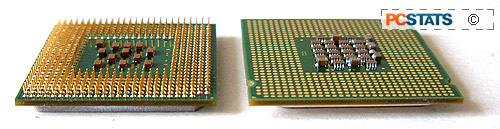
On the left above is the previous socket 478 style Intel processor, at right the current socket 775 style pinless processor. In all other physical respects the new chips are unremarkable, so let's move on to the socket.
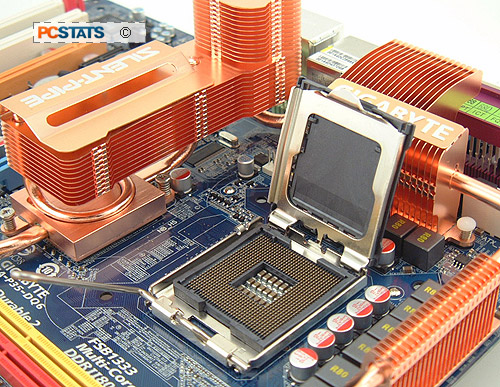
As you can see, the array of pins which connect the processor to the motherboard are now attached to the socket and they are very fragile and easily bent. All socket 775 motherboards feature the metal shim (load plate) pictured above, which serves the dual purpose of locking down the processor once it is installed and protecting the pins from harm when it is not. Most boards also implement a protective plastic cover which fits over the load plate when no processor is present, hiding the pins completely. The lever secures the shim in place, holding the processor when it is installed.

It is extremely important that the processor be installed slowly, carefully and vertically into the socket, and removed the same way. Any careless handling will damage the pins, and may leave you with a useless motherboard.

Now its time to describe exactly how to install one of these chips correctly. It's not the hardest thing in the world, but it pays to be careful and follow a predetermined set of steps.

© 2009 PCSTATS.com
Please respect the time and effort that went into creating each PCSTATS Beginners Guide, do not illegally copy. Thank you.
Next Page >

Toss Some Change into The Tip Jar
For less than the cost of a latté you can let the hardworking staff who write and maintain the GUIDES at PCSTATS know that we've helped you out of a jam, or dished out a bit of great tech advice. Toss in $3 bucks, or whatever spare change you like.

 Page 1:  — DIY Guides: How To Install/Remove Intel Socket 775 CPU and Heatsink
 Page 2:  Installing an LGA 775 Processor Safely
 Page 3:  Inserting the socket 775 CPU the right way
 Page 4:  Locking the Processor in Position
 Page 5:  Apply pressure to the LGA775 CPU
 Page 6:  Installing the CPU Heatsink Correctly
 Page 7:  Removing Socket 775 heatsinks and processors safely
SEARCH PCSTATS NEW - TRY IT OUT!
Use the power of Google to search all of PCSTATS and the PCSTATS Forums. Tell us what you think of this new feature - FEEDBACK?

   20.11.09 | 5:23P
Hardware Sections 
· Beginners Guides
· Cases and Access.
· CD-ROMs
· Chipsets
· Computers / SFF PCs
· Cooling - Heatsinks
· CPU / Processors
· Digital Cameras
· Hard Drives
· Home Theatre
· Memory
· MP3 Players
· Monitors
· Motherboards
· Mouse Pads
· Networking
· Notebooks
· PCs and SFF PCs
· Peripherals
· Powersupply
· Printers
· Servers
· Software / OS
· Videocards
- - -
· Editorials
Industry PR 
» GIGABYTE Unleashes First UD7 Motherboard

» Seagate Ships 2TB ATA 6GB/s Hard Drive

» Corsair Obsidian Series 800D high-performance chassis


google
 
PCstats Network Features Information About Us Rydium Network
FrostyTech
TransmetaZone
BeginnersPC
RamFinder
ShoppingList Assistance
PCstats.com Newsletter
Tech Glossary
Technology WebSite Listings
About Us
Employment / Internships
Privacy Policy
PermaLink News
Archived News
Submit News (Review RSS Feed)
Site Map
PCstats Wallpaper
Rydium Network
Advertising

How's Our Driving?
© Copyright 1999-2009 www.pcstats.com All rights reserved. Privacy policy and Terms of Use.