BACK TO PCSTATS + Motherboards
+ Videocards
+ Memory
+ Beginners Guides
News & Advanced Search  Feedback?
[X]   Directory of
Guides & Reviews
The PCstats Forums

Beginners Guides
Weekly Newsletter
Archived Newsletters

+70 MORE Beginner GUIDES....
Poll: Windows 7
Have you Upgraded to Windows 7?
yes, love it!
nope, staying put
yes, but not happy
Total Votes:  806

 
 [NEW!] 
Gigabyte GA-P55A-UD4P Intel P55 Express Motherboard Review
Beginners Guides: 99 Performance Tips for Windows XP
Beginners Guides: 99 Performance Tips for Windows XP - PCSTATS
Marketplace: $/£/€ Price Search
Abstract: PCSTATS covers all the TechTips you need to push a PC from sluggish to quick. This Guide deals with quicker boot times, making your current hardware work faster, and 99 other Tips from PCSTATS that will help you make your computer run better, quicker, and more efficiently!
 Manufacturer:  Category:  Published:  Author: 
  PCSTATS   Beginners Guides   Dec.25.2009   Mike D.  

WinXP Software and Registry Tweaks: Tips 23 - 25

23. Create a 'permanent' page file

Make the minimum size of the page file the same as the maximum size. This saves the operating system from needing to resize the page file, and does not lose you any extra space, since the 'maximum' size the page file can reach is the amount of hard disk space that is reserved by the OS.

Right click on 'my computer' and select 'properties.'

Select the 'advanced' tab.

Under 'performance' choose the 'settings' button.

Select the 'advanced' tab again and under 'virtual memory' select 'change.'

Highlight the drive containing your page file and make the 'initial size' of the file the same as the 'maximum size' of the file.

24. Optimize your page file size

Windows XP sizes the page file to about 1.5X the amount of actual physical memory by default. While this is good for systems with smaller amounts of memory (under 512MB) it is unlikely that a typical XP desktop system will ever need 1.5 X 512MB or more of virtual memory. As a simplified guideline. If you have less than 512MB of memory, leave the page file at its default size. If you have 512MB or more, change the ratio to 1:1 page file size to physical memory size.

25. Defrag page file with PageDefrag utility

While defragmenting your hard disks is a great idea, and can restore new life to your aging PC, there are certain files that the built in Windows XP defrag utility cannot access, since they are locked or accessed constantly by the operating system. These files include the page file (the area of the hard disk reserved for use as 'virtual' memory for use in addition to the system's physical memory), the event logs, the SAM and security files which handle user authentication and passwords, and several others.

Fortunately, there is a free third party utility available which can completely defragment these important files as well, ensuring that your system is as restored as possible. Sysinternal are the creators of a great many essential freeware programs for all flavours of Windows, and their PageDefrag utility can reorganize these troublesome files upon reboot.

First download and install the utility.
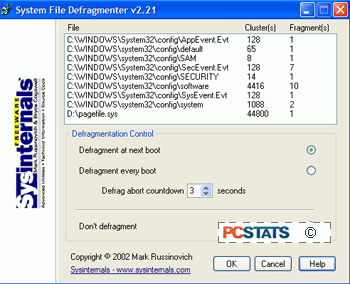
The window displays the list of reserved files, and how fragmented they have become. Choose 'defragment at next boot' then press 'ok.' The next time you restart your computer, PageDefrag will defragment the listed files.

< Previous Page © 2010 PCSTATS.com
Please respect the time and effort that went into creating each PCSTATS Beginners Guide, do not illegally copy. Thank you.
Next Page >

Toss Some Change into The Tip Jar
For less than the cost of a latté you can let the hardworking staff who write and maintain the GUIDES at PCSTATS know that we've helped you out of a jam, or dished out a bit of great tech advice. Toss in $3 bucks, or whatever spare change you like.
 Pg 1.  Beginners Guides: 99 Performance Tips for Windows XP
 Pg 2.  Preparing your system: Tips 1 - 3
 Pg 3.  Preparing your system: Tips 4 - 5
 Pg 4.  Preparing your system: Tips 6 - 8
 Pg 5.  BIOS Tweaks: Tips 9 - 11
 Pg 6.  BIOS Tweaks: Tips 12 - 14
 Pg 7.  Overclocking Memory / CPU: Tips 15 -16
 Pg 8.  WinXP Software and Registry Tweaks: Tips 17 - 20
 Pg 9.  WinXP Software and Registry Tweaks: Tips 21 - 22
 Pg 10.  — WinXP Software and Registry Tweaks: Tips 23 - 25
 Pg 11.  WinXP Software and Registry Tweaks: Tips 26 - 28
 Pg 12.  WinXP Software and Registry Tweaks: Tips 29 - 31
 Pg 13.  WinXP Software and Registry Tweaks: Tips 32 - 35
 Pg 14.  WinXP Software and Registry Tweaks: Tips 36 - 40
 Pg 15.  WinXP Software and Registry Tweaks: Tips 41 - 43
 Pg 16.  WinXP Software and Registry Tweaks: Tips 44 - 45
 Pg 17.  WinXP Software and Registry Tweaks: Tips 46 - 48
 Pg 18.  Video and Graphics Tweaks: Tips 49 - 52
 Pg 19.  Video and Graphics Tweaks: Tips 53 - 54
 Pg 20.  Video and Graphics Tweaks: Tips 55 - 57
 Pg 21.  Network and Internet Speed Tweaks: Tips 58 - 61
 Pg 22.  Network and Internet Speed Tweaks: Tips 62 - 63
 Pg 23.  Network and Internet Speed Tweaks: Tips 64 - 66
 Pg 24.  WinXP Interface Tweaks and Shortcuts: Tips 67 - 69
 Pg 25.  WinXP Interface Tweaks and Shortcuts: Tips 70 - 73
 Pg 26.  WinXP Interface Tweaks and Shortcuts: Tips 74 - 77
 Pg 27.  WinXP Interface Tweaks and Shortcuts: Tips 78 - 81
 Pg 28.  Improving Windows XP boot speed: Tips 82 - 84
 Pg 29.  Improving Windows XP boot speed: Tips 85 - 88
 Pg 30.  Improving Windows XP boot speed: Tips 89 - 91
 Pg 31.  Improving Windows XP boot speed: Tips 92 - 94
 Pg 32.  Increasing XP shutdown speed: Tips 95 - 99
SEARCH PCSTATS NEW - TRY IT OUT!
Use the power of Google to search all of PCSTATS and the PCSTATS Forums. Tell us what you think of this new feature - FEEDBACK?

   09.02.10 | 2:00P
Hardware Sections 
· Beginners Guides
· Cases and Access.
· CD-ROMs
· Chipsets
· Computers / SFF PCs
· Cooling - Heatsinks
· CPU / Processors
· Digital Cameras
· Hard Drives
· Home Theatre
· Memory
· MP3 Players
· Monitors
· Motherboards
· Mouse Pads
· Networking
· Notebooks
· PCs and SFF PCs
· Peripherals
· Powersupply
· Printers
· Servers
· Software / OS
· Videocards
- - -
· Editorials
Industry PR 
» GIGABYTE Unleashes First UD7 Motherboard

» Seagate Ships 2TB ATA 6GB/s Hard Drive

» Corsair Obsidian Series 800D high-performance chassis


google
 
PCstats Network Features Information About Us Rydium Network
FrostyTech
TransmetaZone
BeginnersPC
RamFinder
ShoppingList Assistance
PCstats.com Newsletter
Tech Glossary
Technology WebSite Listings
About Us
Employment / Internships
Privacy Policy
PermaLink News
Archived News
Submit News (Review RSS Feed)
Site Map
PCstats Wallpaper
Suite66 Advertising Agency
Advertising

How's Our Driving?
© Copyright 1999-2010 www.pcstats.com All rights reserved. Privacy policy and Terms of Use.