BACK TO PCSTATS + Motherboards
+ Videocards
+ Memory
+ Beginners Guides
News & Advanced Search  Feedback?
[X]   Directory of
Guides & Reviews
The PCstats Forums

Beginners Guides
Weekly Newsletter
Archived Newsletters

+70 MORE Beginner GUIDES....
Poll: Windows 7
Have you Upgraded to Windows 7?
yes, love it!
nope, staying put
yes, but not happy
Total Votes:  809

 
Gigabyte GA-P55A-UD4P Intel P55 Express Motherboard Review
DIY Guides: How To Install/Remove Intel Socket 775 CPU and Heatsink
DIY Guides: How To Install/Remove Intel Socket 775 CPU and Heatsink - PCSTATS
Marketplace: $/£/€ Price Search
Abstract: With Intel's latest processor socket 775 formfactor, Intel has accomplished a couple of noteworthy things. The first was to substantially reduce the complexity and cost of manufacturing.
 Manufacturer:  Category:  Published:  Author: 
  Intel   Beginners Guides   Jan.08.2009   Mike D.  

Installing the CPU Heatsink Correctly

Place your computer case down flat with the motherboard and processor facing you. Remove the heatsink from the processor box and check the bottom to make sure that the thermal interface material on the bottom is undamaged. You don't need to add any additional thermal paste or other materials. If the heatsink didn't come with any thermal compound applied, add a small amount to the top of the Intel processor and spread it around evenly. Never install a heatsink without thermal compound.
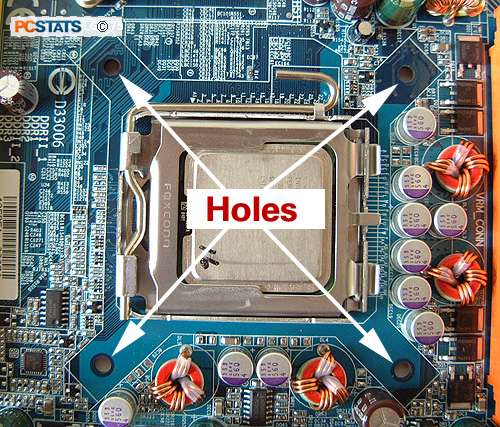
Note the four holes in the motherboard around the socket. These coincide with the 'legs' of your heatsink. Lower the heatsink vertically down onto the processor and socket so that each of the 'legs' lines up with a hole. There is no special way the heatsink has to face, as long as the point on the end of each of the 'legs' fits into one of the holes.
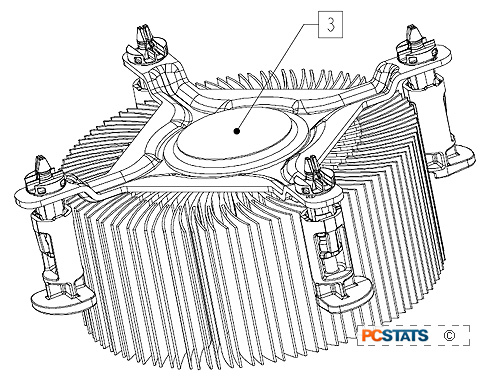
Ensure that the black top of each fastener is rotated into the correct locking orientation, with the arrow pointing away from the heatsink, and the groove in the top oriented towards the center of the heatsink as illustrated below. This orientation ensures the fastener will lock into place when pressed down.
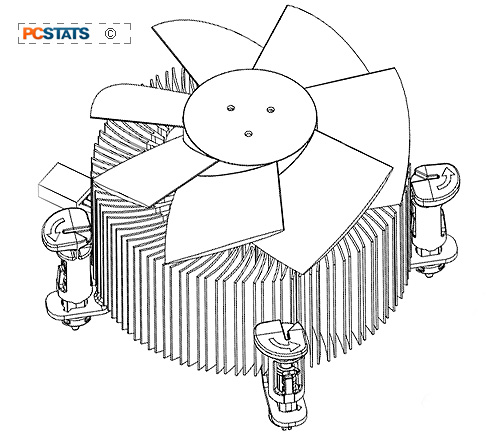
Once the heatsink is sitting on the processor with one fastener in each hole, hold it in place with one hand while pressing down firmly on each of the fastener 'legs' in turn. You should hear a loud click to indicate each clip has snapped into the locked position. Ensure that the heatsink is sitting evenly on top of the socket and processor.
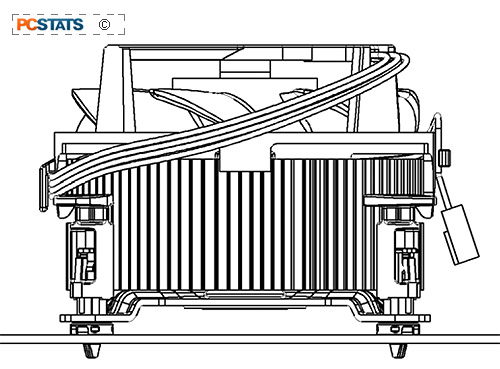
Now attach the fan power cable to the corresponding 4-pin or 3-pin connector on the motherboard.
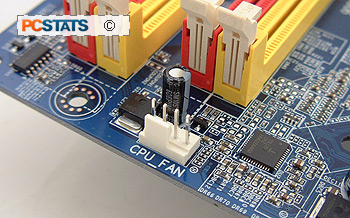
Consult your motherboard manual if you are unsure of the location. Ensure that the cable cannot become snagged in the fan blades. Your processor and heatsink are now installed correctly. Hook up the rest of your system and try them out!

If you need to remove or upgrade the Intel socket 775 processor, that procedure is covered next. You'll need a flathead screwdriver for this, as well as the plastic protective covers for both the socket and the processor.

< Previous Page © 2010 PCSTATS.com
Please respect the time and effort that went into creating each PCSTATS Beginners Guide, do not illegally copy. Thank you.
Next Page >

Toss Some Change into The Tip Jar
For less than the cost of a latté you can let the hardworking staff who write and maintain the GUIDES at PCSTATS know that we've helped you out of a jam, or dished out a bit of great tech advice. Toss in $3 bucks, or whatever spare change you like.
 Pg 1.  DIY Guides: How To Install/Remove Intel Socket 775 CPU and Heatsink
 Pg 2.  Installing an LGA 775 Processor Safely
 Pg 3.  Inserting the socket 775 CPU the right way
 Pg 4.  Locking the Processor in Position
 Pg 5.  Apply pressure to the LGA775 CPU
 Pg 6.  — Installing the CPU Heatsink Correctly
 Pg 7.  Removing Socket 775 heatsinks and processors safely
SEARCH PCSTATS NEW - TRY IT OUT!
Use the power of Google to search all of PCSTATS and the PCSTATS Forums. Tell us what you think of this new feature - FEEDBACK?

   09.02.10 | 5:37P
Hardware Sections 
· Beginners Guides
· Cases and Access.
· CD-ROMs
· Chipsets
· Computers / SFF PCs
· Cooling - Heatsinks
· CPU / Processors
· Digital Cameras
· Hard Drives
· Home Theatre
· Memory
· MP3 Players
· Monitors
· Motherboards
· Mouse Pads
· Networking
· Notebooks
· PCs and SFF PCs
· Peripherals
· Powersupply
· Printers
· Servers
· Software / OS
· Videocards
- - -
· Editorials
Industry PR 
» GIGABYTE Unleashes First UD7 Motherboard

» Seagate Ships 2TB ATA 6GB/s Hard Drive

» Corsair Obsidian Series 800D high-performance chassis


google
 
PCstats Network Features Information About Us Rydium Network
FrostyTech
TransmetaZone
BeginnersPC
RamFinder
ShoppingList Assistance
PCstats.com Newsletter
Tech Glossary
Technology WebSite Listings
About Us
Employment / Internships
Privacy Policy
PermaLink News
Archived News
Submit News (Review RSS Feed)
Site Map
PCstats Wallpaper
Suite66 Advertising Agency
Advertising

How's Our Driving?
© Copyright 1999-2010 www.pcstats.com All rights reserved. Privacy policy and Terms of Use.