BACK TO PCSTATS + Motherboards
+ Videocards
+ Memory
+ Beginners Guides
News & Advanced Search  Feedback?
[X]   Directory of
Guides & Reviews
The PCstats Forums

Nov. ShoppingList
Beginners Guides
Weekly Newsletter
Archived Newsletters

  Press Releases
  Tech Glossary
  Folding Team
  3DMark Team
  Forum Team

+70 MORE Beginner GUIDES....
Poll: Windows 7 Upgrade?
Are you planning on upgrading to Windows 7 on Oct. 28th?
Yes, Windows 7 Here I come!
No, Windows XP still works
No, Windows Vista still works
Total Votes:  3958

The Rydium Network
Sparkle GTX260 Core 216 GeForce GTX 260 Videocard Review
Sparkle GTX260 Core 216 GeForce GTX 260 Videocard Review - PCSTATS
Overall Rating:    81%
Abstract: The Geforce GX 260 core on Sparkle's videocard is clocked at the default speed of 576MHz, the shaders hum away at 1242MHz, while the GDDR3 memory runs at an even 999MHz.

 mfg'r link     category     date published     author    
  Sparkle   Video Cards   May.26.09   J. Apong  


Although it was introduced nearly a year ago, videocards based on nVidia's 'GT200' GPU architecture are still somewhat rare. There are mid-range parts like the nVidia Geforce GTS 250, though these are actually based off of older 'G80' and 'G92' GPUs. Given the ongoing price war of attrition with AMD, it's not surprising that nVidia has driven the prices on its existing line of Geforce GT200-based graphics cards to the point where graphics cards that were previously reserved for the very high end, are now quite affordable mid-range options for the gamer to consider.

Such is the case for the Geforce GTX 260, one of the first videocards based on nVidia's GT200 GPU. Taiwanese hardware manufacturer Sparkle has teamed up with nVidia to produce the Sparkle GTX260 Core 216, a graphics card that stands as a direct challenger to AMD's Radeon 4870 graphics card. The "Core 216" part of the Sparkle GTX260 Core 216 videocard's name refers to the GPU having additional shader processors enabled. While the original Geforce 260 GTX had 192 shader processors, the Core 216 variant has an additional 24 enabled, for a grand total of, you guessed it, 216 shader processors. That means this PCI Express 2.0 x16 videocard has a little more raw computing power than the original Geforce GTX 260 did.

Sparkle's GTX260 Core 216 videocard packs in 896MB of onboard GDDR3 memory, is PCI Express 2.0 x16 compliant and retails for about $210 CDN ($183 USD £116 GBP ). The Geforce GX 260 core on Sparkle's videocard is clocked at the default speed of 576MHz, the shaders hum away at 1242MHz, while the GDDR3 memory runs at an even 999MHz. As you might expect, this dual-slot wide graphics card incorporates nVidia Physx, Cuda, and Hybridpower. From the graphics and eyecandy perspective the Geforce GTX260 GPU supports DirectX10, Shader Model 4.0, OpenGL 2.1, and 128-bit HDR.

Another change from the original Geforce GTX 260 is that the the GT200 B3 revision graphics processor has been die-shrunk from a 65nm to 55nm manufacturing process. The GPU contains an utterly massive 1.4 Billion transistors, squeezed into a die measuring 487mm2 in area. While this should lower nVidia's production costs and make the Sparkle GTX260 Core 216 more affordable for you, and cooler running, nVidia is still playing catch-up to AMD's RV770 GPU, which is smaller still, cooler, and generally more energy efficient.

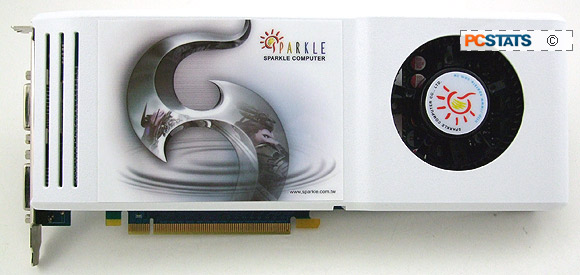
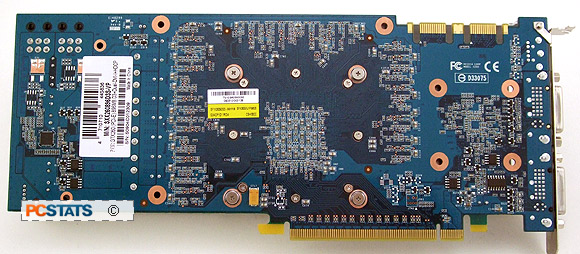
Sparkle GTX260 Core 216 Videocard
(Model No. SXX260896D35-VP)


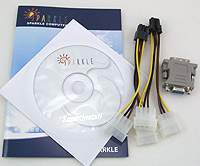
Includes:

User's Manual, Driver CD, DVI-to-Analog converter, (2) SLI 6-pin-to molex power cables.

Like most gaming videocards, the Sparkle Geforce 260 GTX occupies two expansion slots. The cards can be configured with identical graphics adaptors to run in dual or triple-mode SLI on supporting motherboards. It's always a good idea to ensure there's good case airflow so tightly packed graphics cards don't overheat and run their fans a full duty ( the Sparkle videocards' fan isn't particularly loud thankfully).
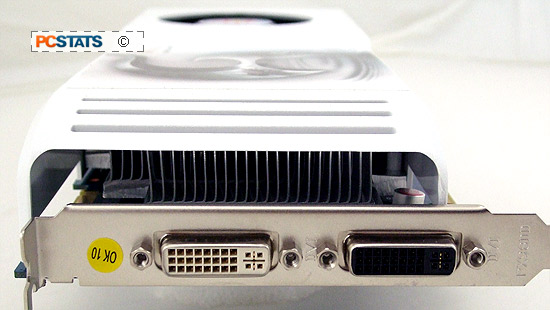
On the I/O panel of the Sparkle GTX260 Core 216 are a pair of DVI ports which support resolutions of up to 2560x1600 pixels. The white adapter is a typical dual-link DVI output, while the black DVI adapter can also carry audio from the on-board S/PDIF header that Geforce videocards use in place of an on-board audio codec. Unfortunately, the Sparkle GTX260 Core 216 videocard doesn't come with an HDMI-to-DVI adapter or the SPDIF jumper cable, so you'll need to pick those items up yourself before you can enjoy sound and video output over HDMI.

The Sparkle GTX260 videocard supports onboard hardware HD decoding technologies care of nVidia PureVideo, so BluRay, H.264, VC-1, MPEG2, or WMV9-encoded media can be played back with little if any CPU load. Oddly, there is no TV-out port for S-Video/component output on this particular videocard.

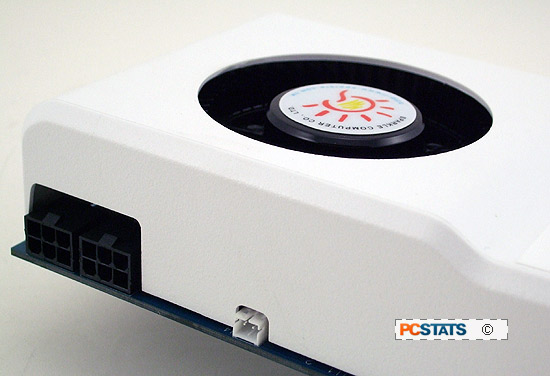
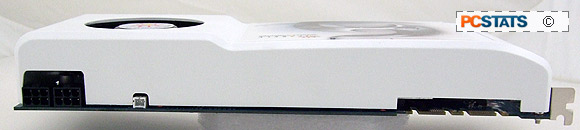
The Sparkle Geforce 260 GTX has an officially related thermal design power of 182W, so it requires two 6-pin PCI Express power adapters. Performance videocards requiring multiple power connectors are pretty common, so power supply manufacturers long ago incorporated the extra power connectors necessary. If your power supply doesn't have the twin 6-pin SLI power connectors, Sparkle have thoughtfully included two molex-to-6Pin power adaptors for you.

Next to the power connections is the 2-pin SP/DIF connector to bring an audio signal into the videocard for users that wish to output 1080i video & sound over HDMI (via HDMI-to-DVI adaptor, not included). To understand where all this firepower comes from, we need to take a look at the nVidia GeForce GTX260 GPU....

© 2009 PCSTATS.com Next Page >


 Page 1:  — Sparkle GTX260 Core 216 GeForce GTX 260 Videocard Review
 Page 2:  nVidia Geforce GTX260 and the GT200 GPU
 Page 3:  Videocard Power Consumption Measurements
 Page 4:  Overclocking a Geforce GTX260 with nVidia nTune
 Page 5:  Videocard Benchmarks: 3DMark06
 Page 6:  DX10 Videocard Benchmarks: 3DMark Vantage, STALKER, Crysis
 Page 7:  DX10 Videocard Benchmarks: Call of Juarez
 Page 8:  DX10 Videocard Benchmarks: Lost Planet
 Page 9:  Videocard Benchmarks: FEAR
 Page 10:  AA/AF Videocard Benchmarks: FEAR AA/AF
 Page 11:  AA/AF Videocard Benchmarks: FarCry 2, Crysis
 Page 12:  Radeon or Geforce GTX260 - Who's the better GPU?
SEARCH PCSTATS NEW - TRY IT OUT!
Use the power of Google to search all of PCSTATS and the PCSTATS Forums. Tell us what you think of this new feature - FEEDBACK?

   20.11.09 | 7:45P
Hardware Sections 
· Beginners Guides
· Cases and Access.
· CD-ROMs
· Chipsets
· Computers / SFF PCs
· Cooling - Heatsinks
· CPU / Processors
· Digital Cameras
· Hard Drives
· Home Theatre
· Memory
· MP3 Players
· Monitors
· Motherboards
· Mouse Pads
· Networking
· Notebooks
· PCs and SFF PCs
· Peripherals
· Powersupply
· Printers
· Servers
· Software / OS
· Videocards
- - -
· Editorials
Industry PR 
» GIGABYTE Unleashes First UD7 Motherboard

» Seagate Ships 2TB ATA 6GB/s Hard Drive

» Corsair Obsidian Series 800D high-performance chassis


google
 
PCstats Network Features Information About Us Rydium Network
FrostyTech
TransmetaZone
BeginnersPC
RamFinder
ShoppingList Assistance
PCstats.com Newsletter
Tech Glossary
Technology WebSite Listings
About Us
Employment / Internships
Privacy Policy
PermaLink News
Archived News
Submit News (Review RSS Feed)
Site Map
PCstats Wallpaper
Rydium Network
Advertising

How's Our Driving?
© Copyright 1999-2009 www.pcstats.com All rights reserved. Privacy policy and Terms of Use.