BACK TO PCSTATS + Motherboards
+ Videocards
+ Memory
+ Beginners Guides
News & Advanced Search  Feedback?
[X]   Directory of
Guides & Reviews
The PCstats Forums

Beginners Guides
Weekly Newsletter
Archived Newsletters

+70 MORE Beginner GUIDES....
Poll: Windows 7
Have you Upgraded to Windows 7?
yes, love it!
nope, staying put
yes, but not happy
Total Votes:  806

 [NEW!] 
Gigabyte GA-P55A-UD4P Intel P55 Express Motherboard Review
Intel Pentium D 840 Dual-Core LGA775 Processor Review
Intel Pentium D 840 Dual-Core LGA775 Processor Review - PCSTATS
Overall Rating:   79%
Abstract: This 90nm processor uses a pair of Prescott cores running at 3.2GHz to bring multi-processing to the desktop in a LGA775 pinless package.

 mfg'r link     category     date published     author    
  Intel   CPU / Processors   Aug.17.05   Mike D.  


Apparently chafing under the invisible restrictions of Moore's law, Intel and AMD spent 2004 searching for ways of further improving processor designs that had virtually reached their maximum speeds under current manufacturing technologies. Both companies changed processor naming schemes and tinkered with cache sizes, while Intel flirted with changing the basic design of the Pentium 4 to mirror that of its highly successful Pentium M mobile CPU.

AMD was apparently first to hit on a possible answer to the dilemma facing them. If one chip was good, two chips must be better! Multiple CPU machines have existed for years at the business level, and the performance advantages are well understood, so why not cram two cores into a single processor die and bring multiprocessing to the desktop?

Predicably, both companies dived head first into this new market, promising (and eventually delivering) dual-core desktop processors and chipsets. Intel split its dual-core offerings into two product lines; the high-end Pentium Extreme Edition clocked at 3.2GHz using the company's Hyperthreading technology, and the mainstream Pentium D 840, 830 and 820 processors clocked at 3.2GHz, 3.0GHz and 2.8GHz respectively without Hyperthreading.

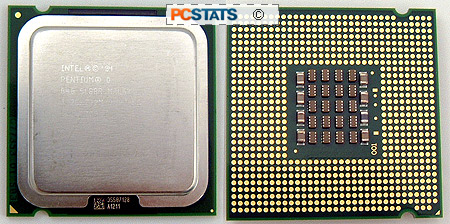
As the Intel Pentium Extreme Edition is priced beyond the grasp of most consumers, PCSTATS has opted to forego that CPU in favour of the flagship Intel Pentium D 840 processor, clocked at a respectable 3.2GHz and retailing for about $740CDN ($650USD). I should also mention our thanks to DAIWA Distribution for helping to facilitate this review. This 90nm processor uses a pair of Prescott cores running at 16 x 200MHz to bring multi-processing to the desktop in a LGA775 pinless package.

Intel Pentium D-840 Processor
Tech Specs
Clock: 3.2GHz
Dual Core: Yes
L1: 16KB (ea. core)
L2: 1MB (ea. core)
Multipiler: 16x
Package: LGA775
Core: 90nm
Cost:
$650USD

The most obvious new feature of the LGA775 Intel Pentium D 840 processor is its dual-core nature. The processor is literally composed of two Prescott Pentium 4 cores stuck together with a pair of interfaces to the system bus. We'll cover the technology behind Intel's approach to dual-core more a little later in the review.

The Pentium D line of processors (models include 820, 830 and 840) are built on the 90nm process and incorporate 230 million transistors. The Intel Pentium D 840 has a maximum power requirement of 130Watts (as opposed to 169million transistors and 115W for the 3.8GHz P4 670). Each core has access to its own L1 and L2 cache memory, 16KB and 1MB respectively. All current dual core processors use the 800MHz FSB like traditional Prescott Pentium 4s, and currently are only supported on DDR II memory platforms. We'll cover the available chipsets for the Pentium D in a moment.

© 2010 PCSTATS.com Next Page >


 Page 1:  — Intel Pentium D 840 Dual-Core LGA775 Processor Review
 Page 2:  State of the art CPU
 Page 3:  Intel's Dual Core Technology
 Page 4:  Intel 955X Express Chipset
 Page 5:  Intel 945P/G chipset
 Page 6:  Intel E7230 Server Core Logic
 Page 7:  Pinless LGA775 Package
 Page 8:  Overclocking Intel's new dual-core processor
 Page 9:  Benchmarks: SysMark 2004
 Page 10:  Benchmarks: Winstone 2004, Cinebench 2003
 Page 11:  Benchmarks: Cinebench 2003 64-bit, Maya
 Page 12:  Benchmarks: ScienceMark 2.0 in 32-bit and 64-bit
 Page 13:  Benchmarks: SuperPI, Hexus piFast
 Page 14:  Benchmarks: Sandra 2005, POVray
 Page 15:  Benchmarks: PCMark04, PCMark05
 Page 16:  Benchmarks: 3DMark2001, 3DMark05
 Page 17:  Benchmarks: Comanche 4, UT2003
 Page 18:  Benchmarks: UT2004, Doom3
 Page 19:  Intel's dual-core Workhorse

   09.02.10 | 3:30P
Hardware Sections 
· Beginners Guides
· Cases and Access.
· CD-ROMs
· Chipsets
· Computers / SFF PCs
· Cooling - Heatsinks
· CPU / Processors
· Digital Cameras
· Hard Drives
· Home Theatre
· Memory
· MP3 Players
· Monitors
· Motherboards
· Mouse Pads
· Networking
· Notebooks
· PCs and SFF PCs
· Peripherals
· Powersupply
· Printers
· Servers
· Software / OS
· Videocards
- - -
· Editorials
Industry PR 
» GIGABYTE Unleashes First UD7 Motherboard

» Seagate Ships 2TB ATA 6GB/s Hard Drive

» Corsair Obsidian Series 800D high-performance chassis


google
 
PCstats Network Features Information About Us Rydium Network
FrostyTech
TransmetaZone
BeginnersPC
RamFinder
ShoppingList Assistance
PCstats.com Newsletter
Tech Glossary
Technology WebSite Listings
About Us
Employment / Internships
Privacy Policy
PermaLink News
Archived News
Submit News (Review RSS Feed)
Site Map
PCstats Wallpaper
Suite66 Advertising Agency
Advertising

How's Our Driving?
© Copyright 1999-2010 www.pcstats.com All rights reserved. Privacy policy and Terms of Use.