The past 16 months or so have seen an unprecedented number of genuine
breakthroughs in the field of processor design, especially from AMD. Not
only did that company introduce a truly compatible 64-bit processor design which
has since dominated the high-end desktop PC market, but it also pioneered the
on-die memory controller which has given the Athlon 64 and Opteron chips a
leg-up in performance over Intel's offerings. Intel has since adopted
64-bit compatibility also, and now both companies are releasing processors with
another brand new feature, dual-cores.
Dual-core processors work pretty much as you'd expect them to. At their
most basic, both Intel and AMD have taken two mostly (or in the case of Intel,
fully) functional processor cores and joined them together in a single processor
die. Each core functions and processes data independently, and the two are
co-coordinated by the operating system software.
In this article, PCSTATS is going to focus on both company's versions of this
technology, how it works, and the kind of performance boost you can expect from
it. Currently only certain of AMD's Opteron server-class processors are
available with dual cores, but very shortly AMD will release the Athlon 64 X2
line of dual-core desktop processors. Intel has taken the opposite
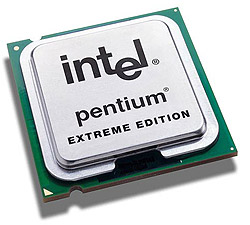
approach, already releasing the 'Pentium Extreme Edition 840' desktop dual-core
chip, while its 'Pentium D' and dual-Xeons lines are not far behind.
Since dual-core processors are essentially a multi-processor system in a
convenient package, let's start by looking at some of the multi-processor
technologies which have contributed to AMD and Intel's newest products.
SMP (Symmetric Multi-Processing)
SMP is the
most common approach to creating a multi-processor system, in which two
or more separate processors work together on the same motherboard. The processors
co-ordinate and share information through the system bus, and the
processors arbitrate the workload amongst themselves with the help of the motherboard
chipset and the operating system.
The OS
treats both processors more or less equally, assigning work as needed.
Both AMD and Intel's new dual-core chips can be considered SMP capable
(internally). AMD's dual-core Opteron server processors can be linked to
other dual-core chips externally also, but this capability is not present in
either company's desktop dual-core lines.
 The major
limitations of SMP have to do with software and operating system support. Many operating systems (such as Windows XP Home)
are not SMP capable and will not make use of the second
physical processor. Also, most modern programs are single-threaded, meaning that there is only
ever one current set of linked instructions and data for them. This
means that only one processor can effectively work on them at a time.
Multi-threaded programs do exist, and can take better advantage of the
potential power of dual- or multi-CPU configurations, but are not as common as we
might like.
The major
limitations of SMP have to do with software and operating system support. Many operating systems (such as Windows XP Home)
are not SMP capable and will not make use of the second
physical processor. Also, most modern programs are single-threaded, meaning that there is only
ever one current set of linked instructions and data for them. This
means that only one processor can effectively work on them at a time.
Multi-threaded programs do exist, and can take better advantage of the
potential power of dual- or multi-CPU configurations, but are not as common as we
might like.
No other current mainstream desktop processors are SMP capable, as Intel and
AMD tend to restrict cutting edge technologies to the higher-end server processors such as
the Opteron and Xeon. In the past though, mainstream processors have been
SMP capable, most notably the later Intel Pentium 3 processors.






 RSS Newsletter